BRONZE BY AUGUSTE CAIN
A BRIEF HISTORY
A singular journey for this artist (1821-1894) who, after working in the family butcher shop, practiced wood carving with Alexandre Guionnet, then became a pupil of François Rude, the sculptor of La Marseillaise on the Arc de Triomphe in Paris. He began exhibiting at the Salon in 1846 with a wax group titled Warblers Defending Their Nest Against a Dormouse. Subsequently, he partnered with the workshop of sculptor Pierre-Jules Mêne, specializing in small-scale bronzes, whose daughter Julie he married in 1852.
From 1868 onward, he was occupied with major commissions from the State, an objective every sculptor aspires to achieve. His works can be found in Paris in the Tuileries Garden, at the Louvre Palace, in the Luxembourg Garden, at the Hôtel de Ville, as well as at the Château de Chantilly, in Nîmes, Poitiers, Geneva, Oran, and Philadelphia.
Auguste Caïn, “the sculptor of lions and tigers,” is to be regarded as a great animalier sculptor of the stature of an Antoine-Louis Barye or a François Pompon.
A NOTE ON CONSERVATION/RESTORATION
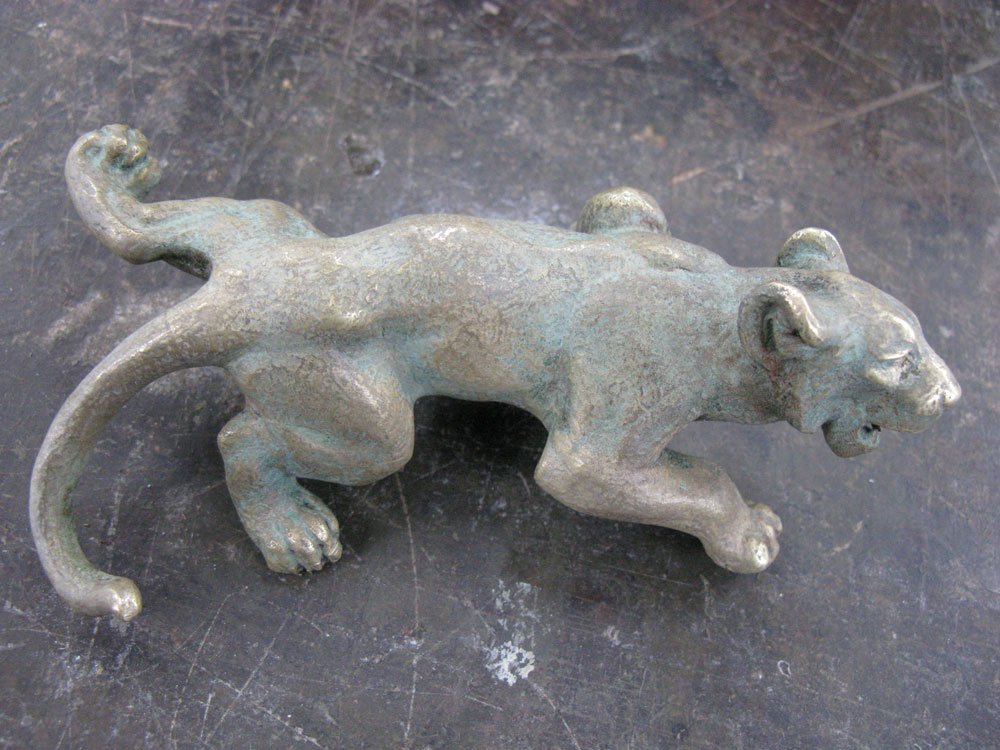
Working on such an object is always an exceptional moment for me. The goal is to restore its original life without betraying its aesthetic message. In this case, the patina had largely disappeared, with only a few traces remaining. Oxidation had also begun its undermining work.
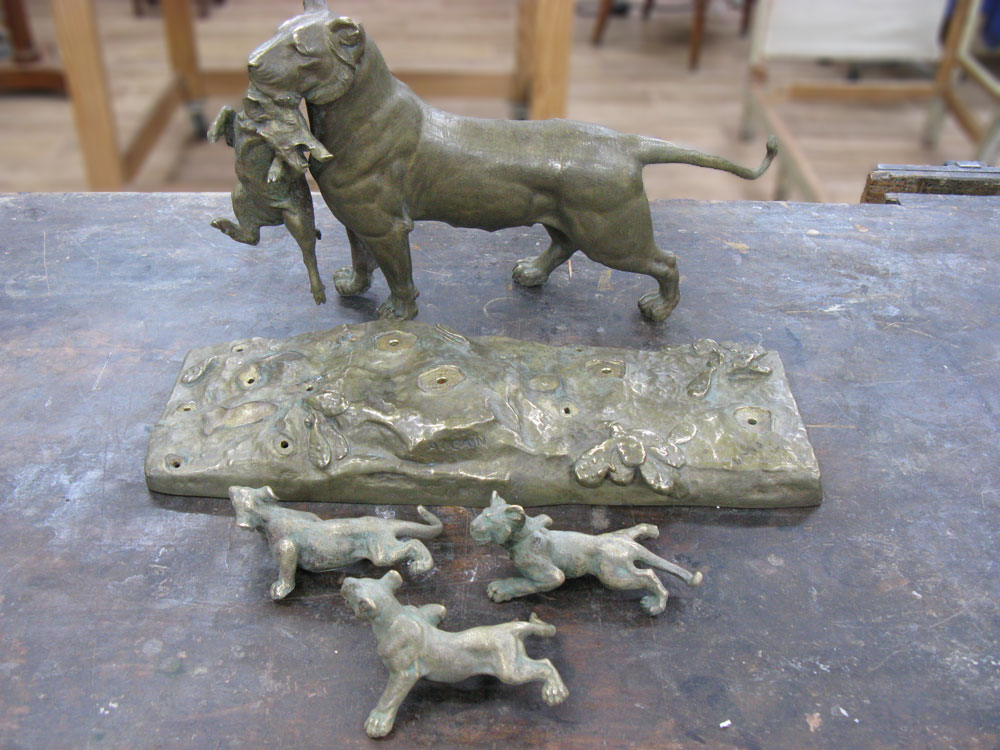
Faced with this challenge, I disassembled the bronze, degreased it with a mild solvent, then proceeded with spot deoxidation through chemical treatment while monitoring its neutralization.
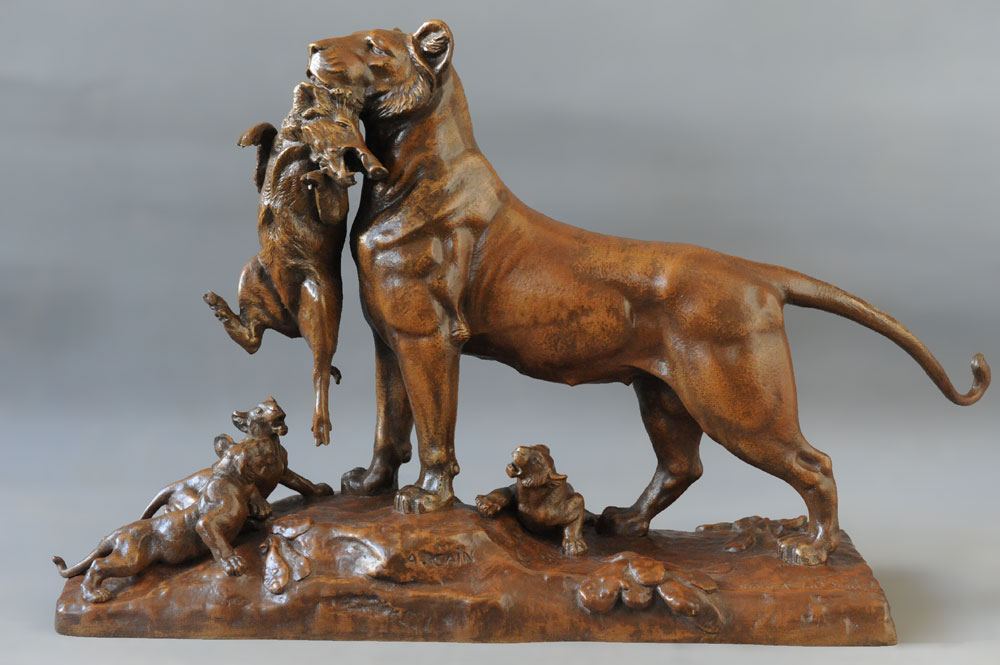
The patina, for reasons of reversibility, was applied using pigments incorporated into an acrylic binder. Given the conservation environment of this charming sculpture, I opted for protection using a wax blend.