EMPIRE COMMODE
A BRIEF HISTORY
Before referring to the piece above as a “commode,” it is important to note that the adjective “commode” (meaning convenient) was originally applied to certain chests of drawers. According to Count de Salverte (1872-1924), it is an old medieval sideboard to which the refinements of the cabinet—namely, drawers—were later adapted.
If we are to believe the description in the Garde-Meuble journal dated May 17, 1692, it was André-Charles Boulle who originated the commode around 1690.
In the 18th century, it became one of the fundamental elements of French furniture, adopted both by the aristocratic circle and by the provincial bourgeoisie, and from 1730 onward, regional commodes appeared that were by no means rustic in style.
The commode is typically crafted in solid wood or veneered with walnut, mahogany, etc., most often topped with marble.
A NOTE ON CONSERVATION/RESTORATION
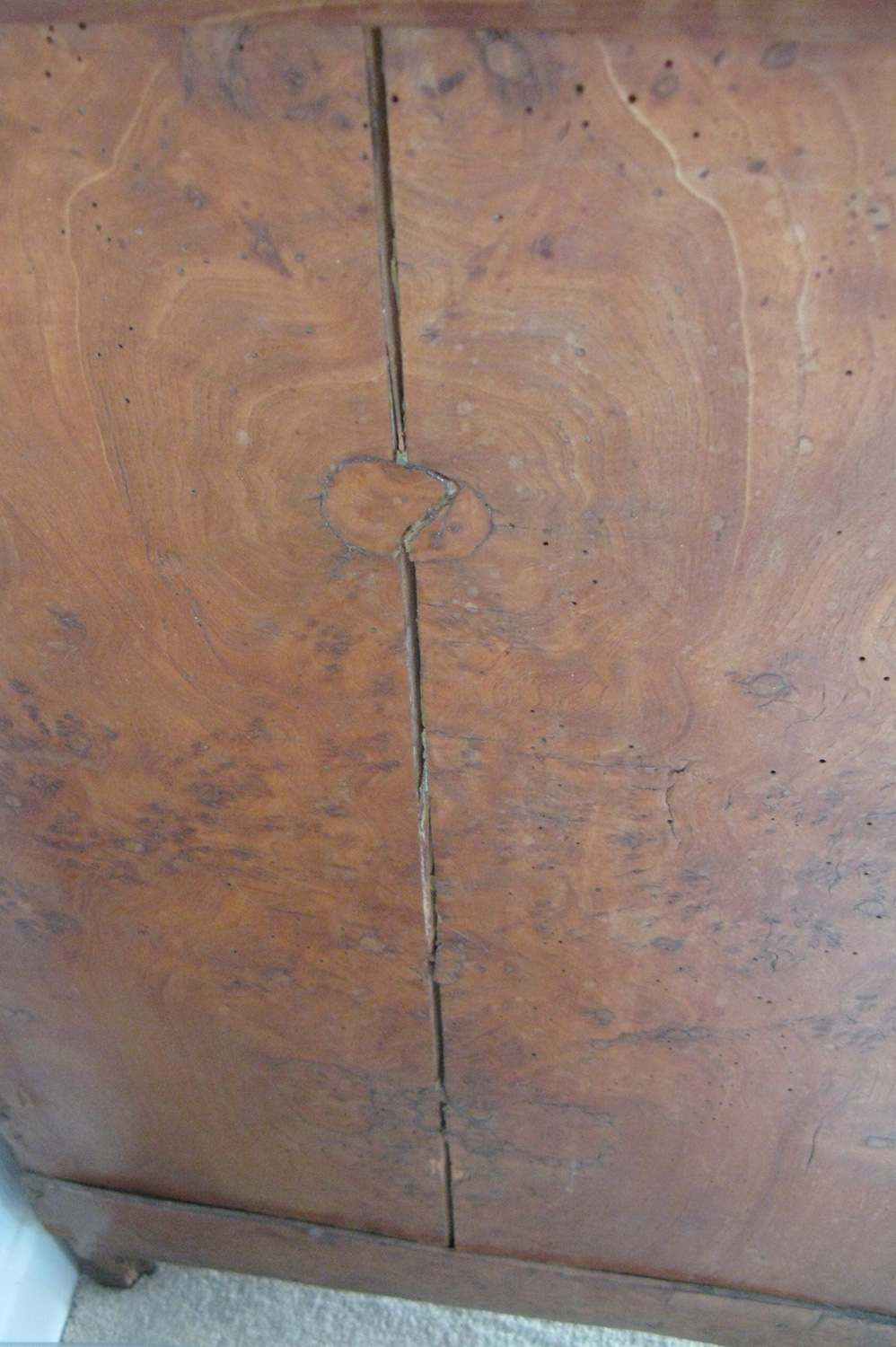
The commode above, veneered with ash burl, is an Empire-style commode featuring a straight front and a massive vertical presence emphasized by the three drawers and the straight columnar stiles.
Upon arrival at the workshop, it was in poor condition, severely degraded by dimensional variations, with veneer torn away in numerous places, and a structure greatly weakened by woodworm attack.
Such a piece must be flawless after intervention by the conservator-restorer. Therefore, I restored the veneer, preserving the remaining original material, and consolidated the frame by injecting reinforcing resins, following a process that restores to the treated parts the same density and mechanical strength values as the original wood.
The wormholes were filled. The finish is a waxed fill.